Battery + Solar Integration — Logistics & Distribution Case Study | Skyline DC Energy
Skip to main content
Back to Home
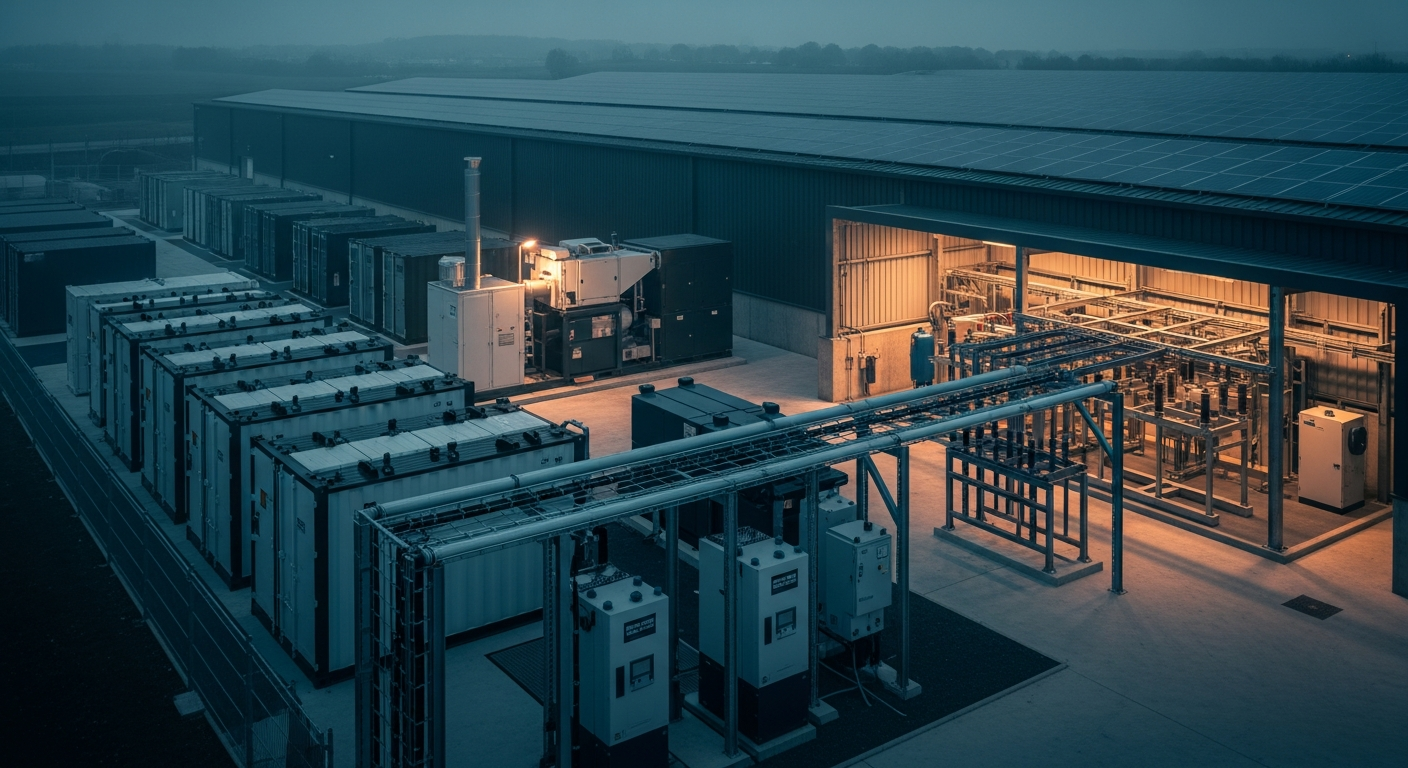
Logistics warehouse with solar and battery
Delivered

Battery + Solar Integration

Logistics & Distribution

Designed a hybrid 2MWp solar array with a 1MWh BESS for a 24/7 cold storage facility, eliminating peak tariffs and providing UPS-grade backup for critical refrigeration.

£112k

Annual Savings

4.2 yrs

Payback Period

£340k

10-Year NPV

The Client

A 200,000 sq ft cold storage and distribution centre in the East Midlands, operating 24/7 with a 1.8MW peak demand. The facility stores frozen and chilled goods for a major supermarket chain, with temperature compliance regulated by the Food Standards Agency. A grid outage lasting more than 4 hours would result in a £50,000+ stock loss and potential regulatory action.

The Challenge

The facility's electricity bill was £420,000 per year, with 40% of the cost driven by peak demand charges. The site had a 1MW grid connection, but the refrigeration demand was 1.2MW continuous, plus 600kW for conveyors, lighting, and office equipment. The peak demand was 1.8MW, triggering capacity charges of £50/kW per month — £108,000 per year.

The site had 15,000m² of roof space with a south-facing orientation, ideal for solar. The management wanted to reduce costs and add resilience, but they were not willing to invest in a system that did not provide UPS-grade backup. The risk of a stock loss was too high.

The Skyline Approach

We analysed 12 months of half-hourly consumption data and identified the peak demand pattern. The refrigeration demand was steady, but the peak was driven by the 6am startup — when all compressors started simultaneously. The peak lasted 45 minutes and was responsible for 60% of the annual capacity charges.

  • 6am compressor startup drove 60% of annual capacity charges — a solvable peak
  • Battery sized to absorb the startup surge; grid only sees 600kW instead of 1.8MW
  • Solar excess stored for evening discharge — 10× more value than grid export
  • LFP chemistry chosen for 2,000-cycle warranty and built-in UPS capability

The solution was a hybrid system: a 2MWp solar array for daytime generation, and a 1MWh battery system for peak shaving and backup. The battery would absorb the 6am startup surge, and the solar would offset the daytime baseload.

The Solution

2MWp Solar Array

Rooftop array on 12,000m² of warehouse roof. Generates 1,800MWh/year, offsetting 60% of the site's daytime consumption. The array is divided into 4 zones, each with independent inverters for fault tolerance.

1MWh BESS

Lithium iron phosphate (LFP) battery system with 2,000 cycle warranty. Charges overnight at 12p/kWh and discharges during peak hours at 78p/kWh. Provides 45 minutes of full-load backup for refrigeration.

The Results

MetricBeforeAfter
Annual grid consumption7,200 MWh4,800 MWh (-33%)
Peak demand charges£108,000/year£18,000/year (-83%)
Solar self-consumption01,800 MWh/year
Battery arbitrage0£54,000/year
UPS backup duration0 minutes45 minutes

The Peak Shaving Effect

The most significant impact was the peak demand reduction. Before the battery, the site's demand profile showed a 1.8MW spike at 6am every day. After the battery, the spike was eliminated. The battery discharges 1.2MW during the startup window, and the grid only sees 600kW. The capacity charge dropped from £108,000 to £18,000 — a saving of £90,000 per year.

The battery also provides arbitrage savings. It charges overnight at 12–15p/kWh and discharges during the evening peak at 78p/kWh. The daily cycle is 800kWh, and the average price spread is 60p/kWh. The daily arbitrage is £480, or £54,000 per year. The battery cost £180,000, so the arbitrage alone pays for the battery in 3.3 years.

The Backup Resilience

The backup capability was the deciding factor for the client. The 1MWh battery can power the refrigeration system for 45 minutes at full load. This is not enough for an extended outage, but it is enough for the most common scenario: a brief grid fault that lasts 5–15 minutes. The battery also provides a seamless transition to the site's diesel generator, which starts automatically after 30 seconds.

In the 8 months since installation, the battery has responded to 4 grid faults. In each case, the refrigeration system was unaffected, and the staff did not notice the transition. The client has not had a stock loss since installation.

The Hybrid Advantage

The solar array and battery are complementary, not additive. The solar array generates 1,800MWh per year, but the site's daytime consumption is only 1,200MWh. Without the battery, the excess 600MWh would be exported to the grid at 8p/kWh — a low value. With the battery, the excess is stored and used during the evening peak, where it displaces 78p/kWh grid imports. The battery increases the value of the solar by 10x during peak hours.

If your site has a high peak demand and a large roof area, a hybrid solar-plus-battery system may be the right answer. We offer free feasibility studies that model your specific load profile and roof area.

See What We Can Do for Your Site

No commitment, no cost — just a detailed assessment of your site's energy potential, with clear recommendations and financial projections.

Ready to Cut Your Energy Costs?

Get a free, no-obligation audit from our certified engineers — and discover exactly where you can save.