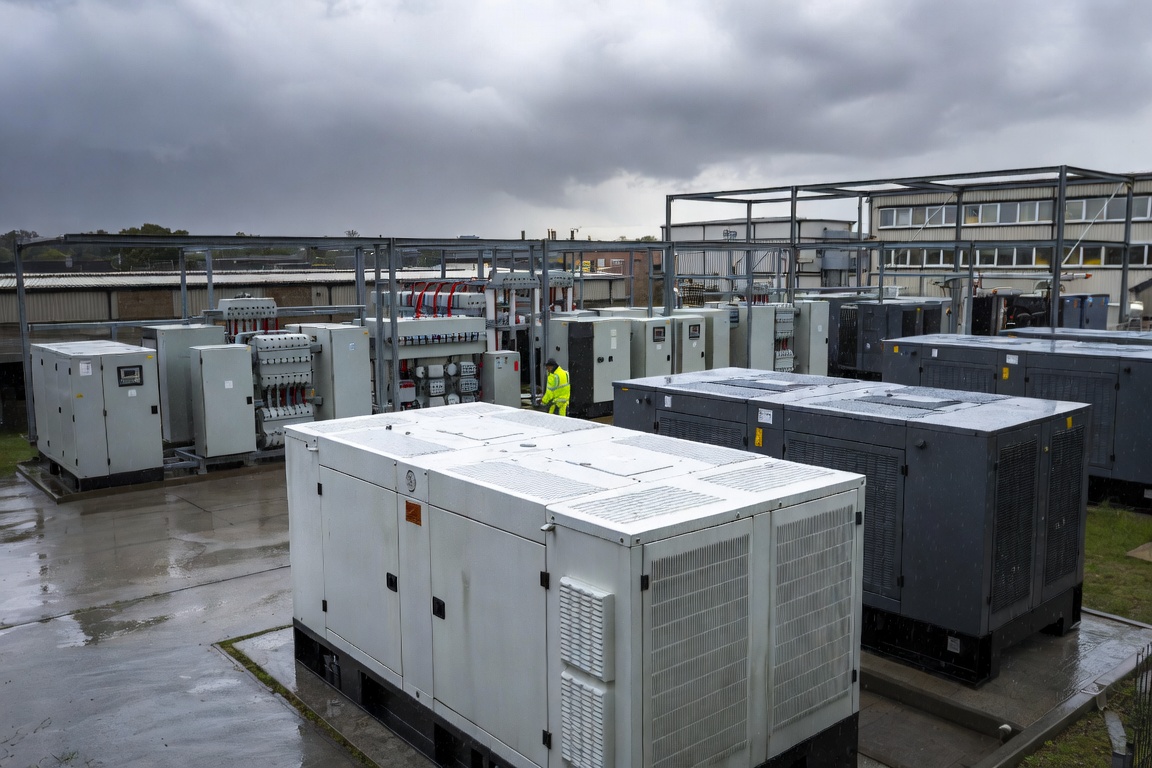
Reliable Standby Power When the Grid Fails
Diesel, gas, and biogas generators for standby and prime power — with automatic failover, UPS and solar integration, fuel management, and comprehensive service contracts for sites where continuity is non-negotiable.
What You Need to Know
For many UK commercial and industrial sites, the grid is not reliable enough to be trusted unconditionally. Cold stores, data centres, hospitals, manufacturing lines, and water treatment facilities all share a common requirement: the site must continue to function when the upstream supply fails. A diesel or gas backup generator is the most proven and cost-effective technology for providing that assurance — capable of supplying the full site load or a prioritised critical subset, and doing so for hours or days rather than the minutes that a UPS battery alone can provide.
Generator fuel choice depends on the site's infrastructure and carbon objectives. Diesel remains the most common fuel for standby applications because it can be stored on-site indefinitely without grid dependency, making it ideal for remote sites or sites with no gas connection. Natural gas generators are cleaner and eliminate on-site diesel storage and spillage risks, but require a continuous gas supply that may not be available or reliable in all locations. Biogas (biomethane) and HVO (hydrotreated vegetable oil) offer near-carbon-neutral alternatives to diesel with minimal infrastructure changes — HVO in particular is a drop-in diesel replacement that requires no engine modifications and qualifies under most corporate sustainability frameworks. Where the highest availability is required, N+1 parallel generator sets are configured so that any single machine can fail without interrupting supply.
A backup generator is most effective when integrated properly with the rest of the site's power infrastructure. An Automatic Transfer Switch (ATS) detects grid loss within milliseconds and initiates the generator start sequence — but the 10–30 seconds the generator takes to reach stable output must be bridged by an on-line UPS or BESS to prevent even a momentary interruption to critical loads. At sites with solar PV and battery storage, generator controls are configured so the generator only runs when BESS state-of-charge falls below a defined threshold, minimising fuel consumption and engine hours. Skyline DC Energy designs, installs, and maintains backup generation systems under a single contract — including fuel management, weekly auto-start testing, oil analysis, and annual full-load bank testing to BS 7671 and relevant British Standards.
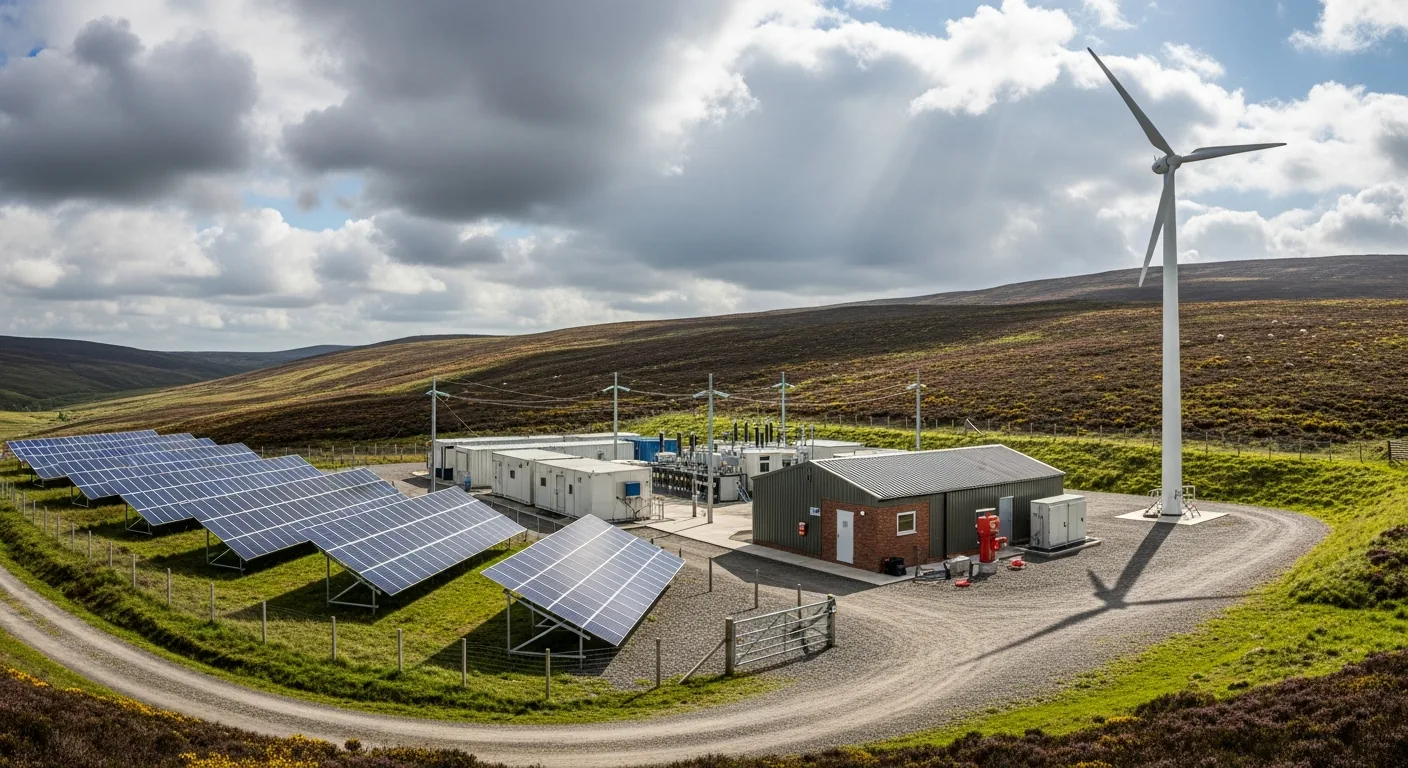
Layered resilience
UPS, battery and generator each cover a different timescale. Layered together, they carry your site from the first millisecond of an outage through to multi-day events.
Layered resilience
From milliseconds to multi-day outages
The Numbers That Matter
- Typical start time
- 10–30 sec
- Available ratings
- 20 kVA–5 MW+
- Fuel consumption
- Site-specific
- Asset life
- 20–30 years
to full load acceptance
diesel, gas, biogas
modelled against load profile
with maintenance contract
Our Delivery Process
Generator specification starts with your critical load profile, acceptable transfer time, and fuel availability. We design for the site, not just the spec sheet.
Load and fuel assessment
We calculate your critical load (kVA), determine essential vs non-essential circuits, and assess diesel, natural gas, or biogas fuel availability and storage constraints.
Generator sizing and selection
Standby or prime-rated generators are sized with appropriate derating for site conditions, with N+1 configurations available for the highest availability requirements.
ATS and controls integration
Automatic Transfer Switch (ATS) panels are designed to coordinate with your existing UPS or BESS — ensuring seamless failover within the UPS ride-through window.
Commissioning and maintenance
Full load bank testing, fuel management system setup, and a preventive maintenance contract covering weekly auto-start tests, oil analysis, and annual load testing.
Proven on Real Sites
Cold Store Logistics Hub, East Midlands
100% uptime sustained through 4 grid outages
Two 500 kVA diesel generators in N+1 configuration, coordinated with a 200 kVA online UPS, provide continuous power protection for a 10,000 m² refrigerated distribution centre — preventing product loss during four grid events over 18 months.
Get a similar resultTechnology-Agnostic. Engineer-Led.
Independent advice
We specify the right technology for your site, not the product we sell.
Whole-life economics
Every recommendation is modelled against your actual half-hourly interval data.
Complete delivery
Design, planning, installation, commissioning, and ongoing optimisation under one contract.
Measurable carbon savings
We quantify Scope 2 reductions for your SECR and ESG reporting.
Proven track record
Projects across manufacturing, food & beverage, logistics, and data centres across the UK.
Performance assurance
Where applicable, generation and savings are backed by contractual performance terms and manufacturer warranties.
Frequently Asked Questions
Free feasibility study
Book a free site assessment
Our engineers review your interval data and deliver a no-obligation feasibility study with technology recommendations, financial modelling, and payback projections.
Request a quote for Backup Generators
Tell us about your site and we'll get back to you within one business day with a tailored proposal.
Sectors We Serve
Aggregates & Heavy Industry
High, spiky power demand and remote sites suit private grid capacity, storage and resilient backup power.
Explore sectorBakeries & Food Production
Constant thermal and refrigeration loads make food production a strong fit for cogeneration, storage and heat recovery.
Explore sectorPublic Sector
Estate-wide carbon targets and constrained capital budgets make funded, measurable energy projects a priority.
Explore sectorFurther reading
Microgrids: When Full Grid Independence Makes Sense
Ready to explore Backup Generators for your site?
Book a free site assessment. Our engineers will evaluate your load profile and deliver a tailored feasibility study.