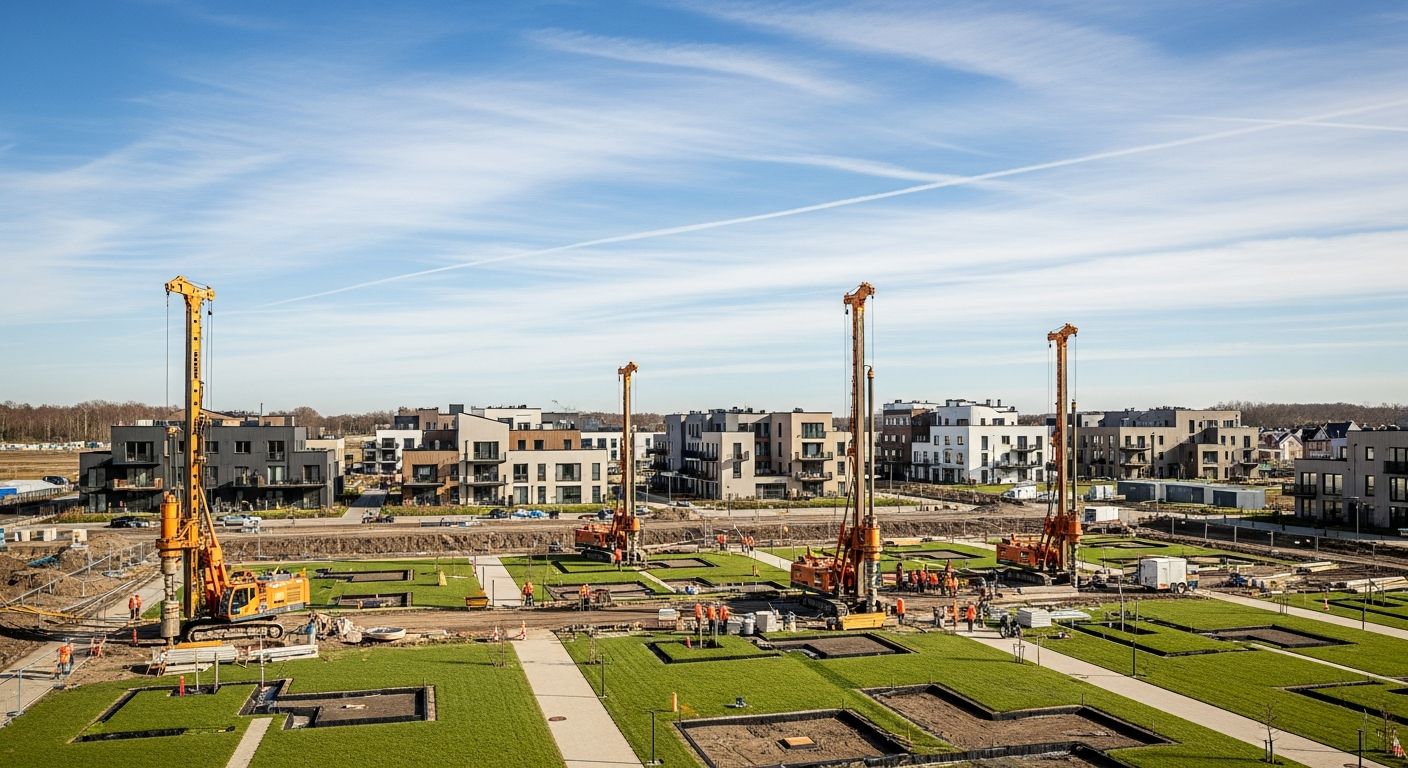
Geothermal Heating Network
Mixed-Use Development
Ground source heat pump network providing zero-carbon heating and cooling across a 400-unit residential/commercial site in Cambridge.
COP 4.3
Seasonal Efficiency
£38k
Annual Savings
6.2 yrs
Payback Period
The Client
A 400-unit mixed-use development in Cambridge, comprising 300 residential apartments and 100 commercial units (retail, office, and gym). The site was designed to net-zero operational carbon standards, and the developer needed a heating and cooling system that could achieve this without fossil fuels.
The Challenge
The site's peak heating demand was 800kW, and the peak cooling demand was 400kW. The developer had considered air source heat pumps (ASHPs) but was concerned about the visual impact of 40 external units on the building's architecture. They also wanted a system that could provide both heating and cooling, and that had a long lifespan with minimal maintenance.
The site had 1.2 hectares of open land that was designated as a communal garden. This land was suitable for a borehole array, but the developer was concerned about the impact on the landscaping and the noise from drilling.
The Skyline Approach
We started with a ground condition survey. The site sits on chalk bedrock at 80m depth, which is ideal for borehole drilling. The ground temperature at 100m is a stable 12°C year-round. We modelled the thermal response of the ground to a 24-borehole array, each 100m deep, and found that the ground would recover between heating and cooling seasons.
- Chalk bedrock at 80m — ideal conductivity for borehole heat exchange
- Stable 12°C ground temperature at 100m eliminates seasonal efficiency swings
- 8.5m borehole spacing (vs standard 7m) added 15% to drilling cost but improved 20-year COP by 0.3, saving £120k
- Ground recovers between heating and cooling seasons — no thermal depletion risk
The key design decision was the borehole spacing. The standard rule of thumb is 7m between boreholes, but our thermal model showed that 8.5m spacing was optimal for this site's load profile. The extra spacing added 15% to the drilling cost but improved the long-term COP by 0.3. Over 20 years, the improved COP saves an additional £120,000.
The Solution
Ground Source Heat Pump
Two 400kW ground source heat pumps with a combined COP of 4.3. The units provide heating at 35°C flow temperature (via underfloor heating) and cooling at 18°C (via chilled ceilings). The units are located in a basement plant room, with no external units.
Borehole Array
24 boreholes, 100m deep, arranged in a 6×4 grid at 8.5m spacing. The array is located beneath the communal garden, with no surface impact after installation. The drilling was completed in 6 weeks, and the landscaping was restored within 3 months.
The Results
| Metric | Gas Alternative | GSHP |
|---|---|---|
| Annual heating cost | £92,000 | £54,000 |
| Annual cooling cost | £18,000 (electric chillers) | £4,000 |
| Total annual cost | £110,000 | £58,000 |
| CO₂ emissions (heating) | 180 tonnes | 0 tonnes |
| System lifespan | 15 years (boiler) | 25+ years (borehole field) |
The Resident Experience
The residents' experience was a key design consideration. The heating is delivered via underfloor heating at 35°C flow temperature, which is comfortable and silent. The cooling is delivered via chilled ceilings at 18°C, which is subtle and avoids the draft of conventional air conditioning. The system is controlled by individual room thermostats, and the residents have reported high satisfaction with the comfort and the low energy bills.
The commercial units have a separate control system that allows the gym to operate at 18°C during peak hours and the offices to operate at 22°C during working hours. The system handles the mixed load seamlessly, and the developer has reported no complaints from the tenants.
The Landscaping Recovery
The developer's concern about the drilling impact was addressed by a phased approach. The drilling was completed in sections, and the landscaping was restored as each section was completed. The borehole field is located 1.5m below the surface, and the garden above is fully functional. The residents are unaware that the garden sits on top of a 24-borehole geothermal array.
The drilling noise was managed by working during weekdays only (9am–5pm) and using low-noise drilling rigs. The developer reported no complaints from the existing residents or the neighbours. The total drilling period was 6 weeks, and the landscaping restoration was completed within 3 months.
The Net-Zero Compliance
The development was designed to meet the Future Homes Standard, which requires a 75–80% reduction in CO₂ emissions compared to current standards. The GSHP system achieves zero operational carbon for heating and cooling, and the solar PV array on the roof offsets the electricity consumption. The combined system meets the net-zero standard without the need for carbon offsets or biomass.
If you are designing a mixed-use development with net-zero requirements, a GSHP system is the most reliable path to compliance. The technology is proven, the economics are compelling, and the resident experience is excellent. We provide a complete GSHP design service that includes ground condition surveys, thermal modelling, borehole design, and system specification.