Combined cooling, heat and power systems are delivering 80%+ efficiency across bakeries, dairies, and cold storage facilities — cutting both costs and carbon.
Why Food & Beverage Is the Perfect Fit
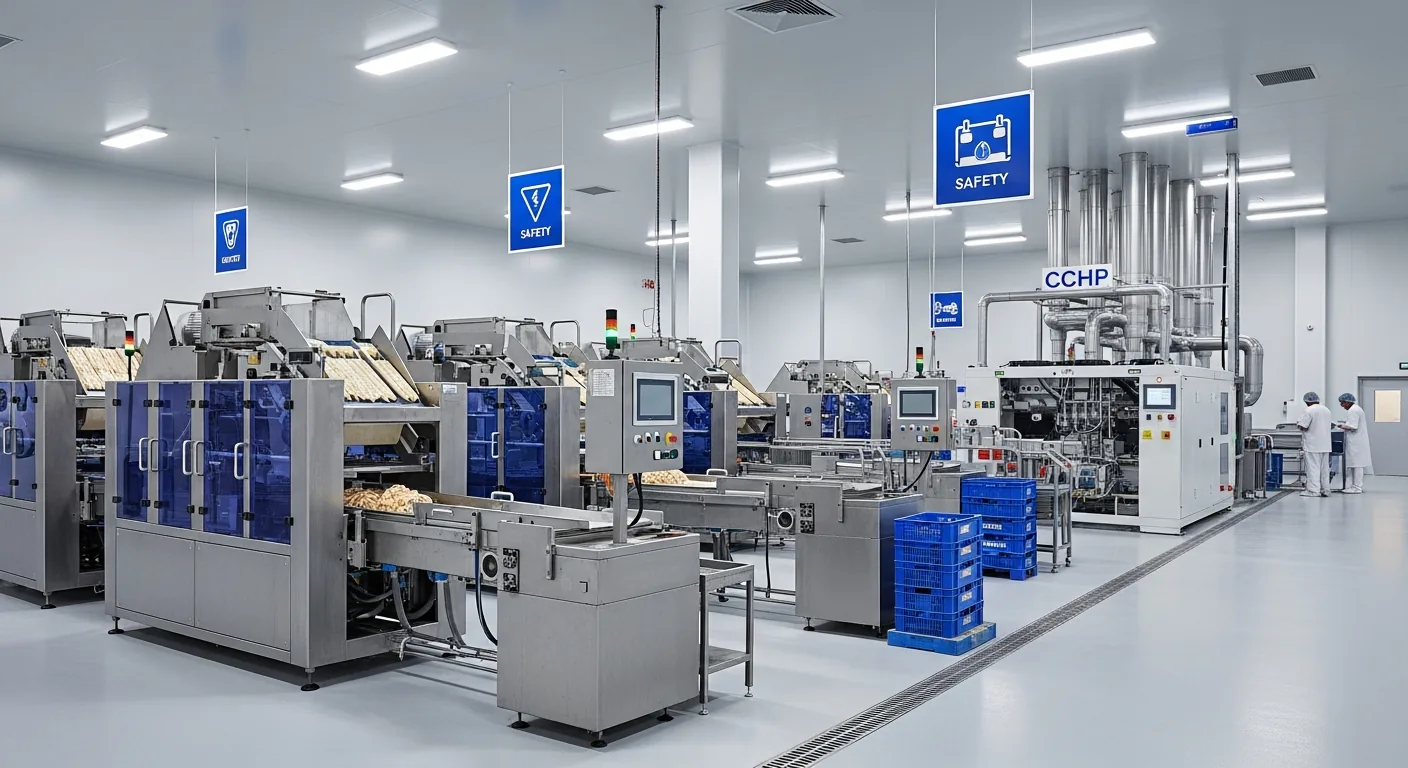
The food and beverage sector has a unique energy profile: simultaneous high demand for electricity, heat, and cooling. A commercial bakery needs electricity for mixers and ovens, heat for proofing and baking, and cooling for blast chillers and refrigeration. A dairy needs heat for pasteurisation, cooling for cold storage, and electricity for processing equipment.
This is the exact profile that Combined Cooling, Heat and Power (CCHP) — also called trigeneration — was designed for. A CCHP unit burns natural gas to generate electricity, captures the waste heat for space heating or process heat, and uses an absorption chiller to convert that same heat into cooling. The result: up to 85% system efficiency, compared to 35–40% for grid electricity plus a separate boiler.
The Baker's Dilemma: Heat vs. Electricity
We recently worked with a large commercial bakery in the Midlands that was consuming 2.8GWh of electricity and 1.4GWh of gas annually. The grid electricity was costing 24p/kWh, and the gas was 8p/kWh. Their total energy bill was £784,000 per year.
The challenge was that their peak electricity demand (1.2MW) coincided with their peak heat demand — when all ovens were running. Grid electricity at that scale was not just expensive; it was subject to peak demand charges of £45/kW per month, adding £64,800 per year in capacity charges alone.
The CCHP Solution
We installed a 1.2MW natural gas CCHP unit with a 300kW absorption chiller. The unit generates 1.2MW of electricity, 1.4MW of heat, and 300kW of cooling simultaneously. The electricity displaces grid imports, the heat replaces the gas boilers, and the cooling serves the blast chillers and cold storage.
Electrical Output
1.2MW baseload electricity displaces grid imports at 24p/kWh. Annual savings: £280,000.
Heat Recovery
1.4MW thermal output replaces gas boilers at 8p/kWh equivalent. Annual savings: £98,000.
Cooling Output
300kW absorption cooling replaces electric chillers at 18p/kWh. Annual savings: £47,000.
The Results: Sharply Lower Grid Reliance
The total annual savings are £425,000. The CCHP unit runs on natural gas at 6.5p/kWh, and the combined electrical, thermal, and cooling output is equivalent to 85% efficiency. The payback period is 3.8 years, and the 15-year NPV is £1.2m.
But the real benefit for the bakery was operational resilience. The CCHP unit provides a baseload electricity supply that is independent of grid volatility. When the grid price spikes — as it did during the April 2026 cold snap — the bakery's marginal electricity cost is locked at the gas price. The gas price is volatile too, but it's far less volatile than electricity, and the site has a 2-year fixed gas supply contract.
The Broader Food & Beverage Opportunity
The bakery is not an outlier. Across the UK food and beverage sector, there are approximately 1,200 sites with energy consumption over 1GWh per year. The majority have a thermal demand that is 40–60% of their total energy consumption. This is the sweet spot for CCHP.
The key is site-specific engineering. A dairy with a 24/7 cold storage requirement has a different load profile from a bakery with a 6am–2pm baking window. The CCHP unit must be sized for the base thermal load, not the peak. Oversizing leads to low run-hours and poor economics. Undersizing misses the full savings opportunity.
What to Consider
CCHP is not a one-size-fits-all solution. It requires a site with a steady thermal demand (heating or cooling) that runs for at least 5,000 hours per year. It requires a gas supply with sufficient capacity. And it requires maintenance planning — the unit needs 4–6 hours of downtime per month for servicing, so the site needs either a backup generator or a grid connection that can cover the gap.
If your site has a high thermal demand and a steady operational profile, CCHP is worth serious consideration. The economics are compelling, the technology is mature, and the carbon savings are significant — the bakery's annual CO₂ emissions fell by 380 tonnes.